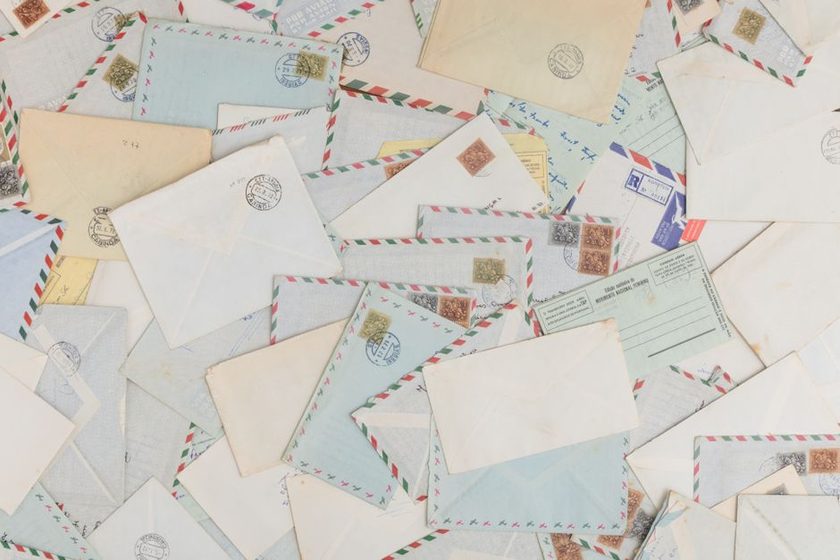
For most of the history of the personal letter, the postscript was not a device. It was an emergency. A sheet of laid paper, already covered edge to edge in a careful hand, left no room to slip in a forgotten line without crowding a margin or starting the letter over — and starting over cost paper and time, plus the risk of a blot worse than the oversight it was meant to fix. So the writer turned the sheet, dropped below the closing, and wrote the missed thought into whatever space remained after the name, after the letter was, in every sense but the literal one, finished. The three letters stood for exactly what they said: post scriptum, after the writing. Three centuries on, the postscript is still with us, but the emergency that produced it is mostly gone, and what replaced it is worth looking at closely.
A Problem of Paper, Not of Prose
Paper before the mid-nineteenth century was neither cheap nor uniform, and a personal letter typically claimed a single sheet, sometimes with a half-sheet folded inside for a longer one. Writers planned the layout before they began — margin, line spacing, how much room the closing would need — because there was rarely a second attempt without waste. Some ran out of space a line and a half from the end of a thought and, rather than compress it to fit, held it back for the space beneath the signature. Others filled the sheet, turned it a quarter turn, and wrote a fresh set of lines directly across the first, a practice called cross-writing, legible only by tilting the page to strong light. Against that backdrop, a short line added after the name was not casual. It was the last resort of someone who had already spent every inch they were willing to.
What the Postscript Actually Fixed
Read a stack of older family letters and the postscripts turn out to be remarkably consistent in kind. A forgotten errand — send the seed catalogue, ask after a cousin's health, confirm the date of a visit. A late piece of news that reached the writer's door after the letter was already composed in their head, if not yet on the page. A brief answer to something the recipient's last letter had asked, which the draft had somehow skipped. None of it was the letter's actual business — that was the news, the account of a harvest or a wedding, the paragraph the writer had sat down specifically to produce. The postscript was whatever was left over: genuinely secondary, genuinely added last.
I have said everything above that I meant to say, and now, at the bottom of the page, I will say the thing I actually meant.— found in a drawer of undated letters, writer unknown
Where the Afterthought Met the Seal
The postscript's position was also a function of how a letter closed. Before the gummed envelope, a folded sheet was closed with a dab of wax or a wafer seal pressed against the outer fold, and once set, the letter was, physically, finished — reopening it to add a line meant breaking a seal that would then need replacing. That gave the postscript a narrow window: after the signature, before the fold, before the wafer went down. A writer who caught a forgotten point at that exact moment had one honest option, and it is the option that gave the device both its name and its place on the page. Miss that window, and the choice was a broken seal or a thought carried to the next letter instead.
Field note: the clearest tell isn't the content of a postscript — it's whether the rest of the letter makes complete sense without it. A letter that reads as finished, with the postscript adding something extra, was probably staged. A letter that trails off, with the postscript the only place a piece of information lands, was more likely genuine.
The Turn: From Slip to Device
Somewhere in the long shift from scarce paper to cheap paper, and from the sealed sheet to the stamped envelope that made a second sheet nearly free, the postscript stopped being forced and became optional — and once optional, it became available for something else. A writer with room to spare could still choose to hold a line back and place it below the signature, not because there was nowhere else to put it, but because that position does something no other line on the page can do. A reader's attention tends to loosen once the signature has passed; the letter proper has been read as composed, maybe even formal, while the postscript reads as spoken, caught, unedited — even when drafted as carefully as everything above it. What began as an artifact of running short on paper became a way of placing the sentence the letter was actually for where it would read as the least important line on the page.
Timing and the Second Thought
Placement is only half of what makes a modern postscript work; timing is the other half. A letter written and posted the same afternoon it was drafted reads differently from one that sat on a desk for three days first, and that gap changes what shows up after the signature as much as it changes the letter itself. An idea that felt essential when the pen first touched the page can look smaller by the time the envelope is sealed, and an idea too minor to mention at the start sometimes turns out to be the only thing worth adding by the end. We've written elsewhere about how a reply's timing shapes what the other person writes back; the postscript is where that same pressure shows up inside a single letter, in miniature — the last line added before the letter leaves the desk.
Reading a Postscript for What It's Doing
Not every postscript is doing this work, and it would be a mistake to treat every line after a signature as a letter's secret point. Some really are what they claim to be — a plain afterthought, added because the writer remembered something on the walk to the mailbox. The difference tends to show up less in what a postscript says than in a handful of smaller signals around it.
- Its length compared to the paragraphs above it — a true afterthought tends to run one line; a deliberate one often earns two or three.
- Whether it answers a question the letter's own paragraphs never raised.
- A shift in tone — more direct, more personal, sometimes the only line in the letter written in the present tense.
- Whether it sits in the same ink and hand as the rest of the page, or reads like it was added at a second sitting.
Laid out by era, the general pattern is easier to see:
| Era | Usual reason | Where it sat | What it tended to signal |
|---|---|---|---|
| Paper-scarce letters, pre-1850s | A genuinely forgotten detail | Below the signature, same sheet, sometimes cross-written | An honest oversight, not a device |
| Victorian and Edwardian correspondence | A social nicety — regards, a health update | Directly beneath the closing | Warmth, courtesy, a personal touch |
| Wartime and wire-era letters | An urgent last word before the letter had to go | Squeezed into a margin or a separate slip | Urgency, immediacy |
| Contemporary handwritten letters | The letter's actual point, held back on purpose | After the signature, often given its own line and space | Intimacy — read as unplanned, drafted as carefully as anything above it |