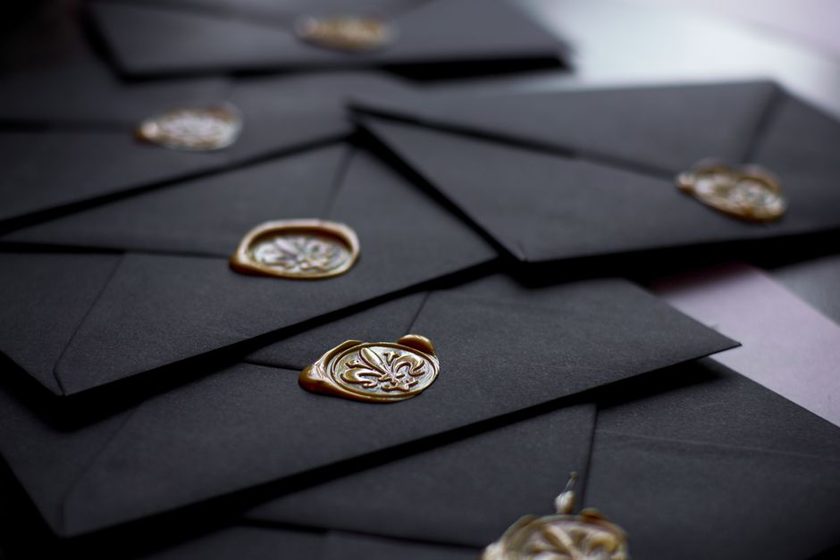
Pull open a drawer of letters older than the ballpoint pen and you will eventually meet a wafer seal — not wax, though it is often mistaken for one at a glance. It is a thin disc, sometimes no bigger than a shirt button, pressed flat and dry against the flap of an envelope or the fold of the letter itself. Where wax announces itself with a raised, glossy lump and the shadow of a signet, the wafer sits almost flush with the paper, as if it had grown there rather than been added to it. It did its quiet work for the better part of two centuries, and it did that work faster and cheaper than anything that had come before. Speed and cost are the whole of its story, and also the reason it eventually disappeared.
Before the Wafer: What Wax Required
Sealing wax was a small ceremony every time. A stick was held over a candle flame until it softened, then tipped so a bead of it dropped onto the fold or flap. The sender pressed a signet ring or a seal matrix into the still-warm wax and held it there while it cooled and hardened around the impression. Done properly it took a minute or two — done badly, the wax cracked, smeared, or refused to hold the design at all. For one letter to a friend, that minute was nothing. For a merchant's clerk closing out the day's correspondence, or a government office moving dozens of dispatches, that minute repeated forty or fifty times was an afternoon.
A Faster, Cheaper Fix
The wafer solved a problem wax never had to solve at small scale: volume. It was a disc pressed from a paste — starch, a plant gum, sometimes a mineral or vegetable tint — rolled thin and dried hard on a sheet, then punched out and sold by the box. To use one, a writer moistened it with a damp sponge or the tip of a tongue, set it on the fold, and pressed the two surfaces of paper together. No flame, no ring, no waiting for anything to cool. It held the letter shut in the time it took to say the sentence describing it.
Manufacturers pressed a paste of starch and gum into thin sheets, tinted with a dye for color, then dried and cut into discs before packaging them by the gross for stationers and offices. The recipe varied by maker, but the goal was always the same: something that held its shape dry, then softened and gripped the moment it met water.
Riding the Cheap-Postage Wave
The wafer's real moment came with the reform of postage rates in the mid-nineteenth century, when sending a letter stopped being priced by distance and folded sheets and became, in some places, a flat and modest sum. Mail volume climbed quickly once the price dropped — accounts from the period describe post offices struggling to keep pace with the new traffic. A fastening method that took a minute per letter did not scale to that; one that took five seconds did. For a stretch of a few decades, the wafer was the seal that matched the speed of the mail it was closing, doing for ordinary correspondence what the envelope's hidden lining would later do for its privacy.
| Period | Fastening | Time to close | What it needed |
|---|---|---|---|
| Before ~1700s | Melted wax + signet | 1–2 minutes | Candle, wax stick, seal matrix |
| Late 1700s–1840s | Gummed wafer disc | Seconds | Water, a steady thumb |
| 1840s onward | Pre-gummed envelope flap | Instant | Nothing extra at all |
| Present day | Adhesive strip or tape | Instant | Nothing to break or read |
What a Broken Seal Revealed
Wax and wafer failed differently, and that difference mattered to a careful reader. A wax seal that had been lifted and reheated tended to lose the crispness of its signet impression — the edges softened, the color sometimes shifted, and a practiced eye could tell the second pressing from the first. A wafer told a plainer, more physical story: it was made of paper fiber gripping paper fiber, so prying it open cleanly, without steam or patience, tended to tear a small ring out of one of the two surfaces it joined.
A seal was never really about secrecy. It was about the shape of the proof — some small sign that someone besides the sender had touched the letter, or hadn't.— noted in passing, an old stationer's turn of phrase
An archivist looking at a wafer-sealed letter today learns to read a few specific signs before deciding what happened to it:
- A slight cockle or ripple in the paper around the disc, left by the original moistening
- A faint ghost ring where the dye bled outward into the fibers as it dried
- A torn rather than lifted edge, suggesting the seal was opened without steam
- A second, fainter ring beneath the visible one, suggesting the letter was resealed with a fresh wafer after the first was removed
Why It Faded
The wafer's decline had the same cause as its rise: a faster method arrived. Once envelope makers began selling flaps with their own gum already applied — lick, fold, done — the separate disc became an extra step rather than a shortcut. By the later part of the century it survived mostly as decoration on formal invitations rather than as a working fastener on ordinary mail, the same slow drift toward ceremony that a full drawer of old correspondence tends to make visible all at once, letter by letter, if you sit with it long enough. What had been a genuine improvement in speed quietly turned into a gesture, kept for the letters where a gesture still seemed worth the trouble.