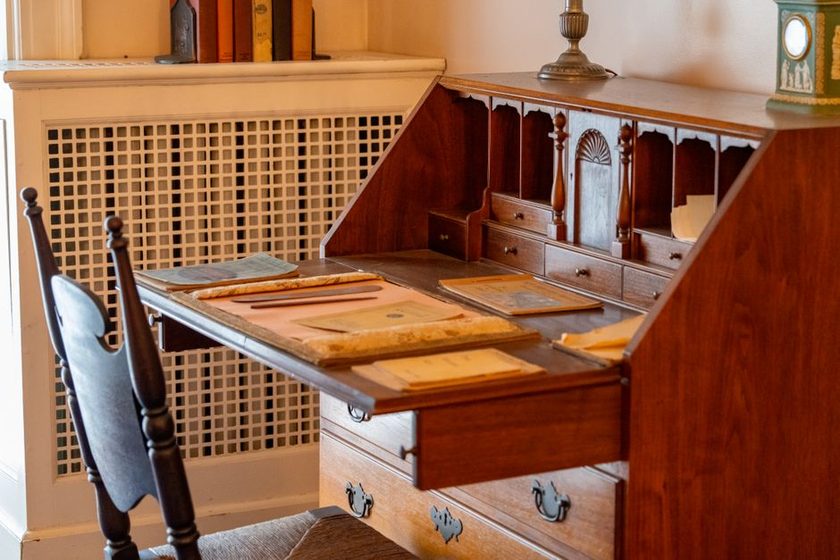
A drawer of someone else's letters, kept in rough order and read straight through, behaves nothing like a single letter read alone. One letter is a mood caught on one afternoon, in one particular weather. A decade of them, gone through in a sitting, is a shape — the fold tightening or loosening over the years, the paper getting thinner or heavier as money or habits changed, the gap between an envelope's arrival and its answer stretching from two days to two weeks and, sometimes, closing again without explanation. None of that shows up in a single sheet. It only appears as a pattern across many letters set side by side, and once you have seen the pattern, it is hard to write your own next letter without noticing what it says.
A Single Letter Lies by Omission
This is not a claim that any one letter is dishonest. It is only that a letter, taken alone, can't tell you what came before it or what it changed. A stiff, formal opening might be the writer's usual register, or it might be the first sign of a cooling that only becomes visible three letters later, when the same phrase turns up again with less warmth around it. A run of letters supplies the context a single one withholds. Read in sequence, the drawer starts to answer questions the writer never directly addressed: who reached out first after a long gap, whose handwriting got smaller under pressure, which year the letters simply stopped for a season and then picked back up as if nothing had happened.
The Fold Tightens as the Years Pass
Fold habits, it turns out, are some of the steadiest tells in a long correspondence. A writer who starts out with a loose, generous double fold — plenty of margin, paper that clearly cost something — will sometimes tighten into a cramped tri-fold as the years and the letters accumulate, less because the sentiment shrank than because the ritual became routine. The tri-fold has its own discontents, and a drawer read in order shows exactly when a writer surrendered to them: the crease gets sharper, more mechanical, less considered, right around the point where letter-writing stopped being an occasion and became a habit.
A working drawer archive is rarely tidy. Expect a mix of stationery weights, at least one stretch of unanswered gaps, envelopes with no letter inside them and letters with no envelope, and a handful of sheets folded so many times the creases have gone soft and pale. None of that is a defect in the record — it is the record. The gaps and mismatches are often more informative than the letters that survived intact.
Paper Choice Follows the Relationship, Not the Occasion
It is tempting to assume paper weight tracks the importance of what's being said — heavier stock for serious news, thin sheets for a quick note. Read across a decade, that assumption mostly falls apart. What paper weight tends to track instead is the state of the relationship at the moment of writing. Paper weight functions as a first sentence before a single word is read, and in a long run of letters that first sentence often shifts gradually: a correspondent who once reached for a substantial, cotton-heavy sheet for routine news might, years later and mid-quarrel, send the same routine news on whatever thin paper was nearest to hand. The words can stay perfectly polite. The paper says something else.
Reply Timing Is the Real Plot
Dates matter more than most readers give them credit for. Line up postmarks or dated headers across a full run and a second, quieter story appears alongside the written one: how long each side waited before answering. A correspondence that opens with same-week replies and drifts, letter by letter, into month-long silences is telling a story the actual sentences may never mention directly. Timing is not a footnote to the content — in a long drawer, it is frequently the content.
The words in a letter are what the writer chose to say. The gap before the reply is what the relationship actually decided.— a pattern that only shows up once you stop reading letters one at a time
| Stretch of the correspondence | Typical paper | Fold | Reply gap |
|---|---|---|---|
| Early years | Heavier, chosen stock | Loose double fold | 3–5 days |
| Mid-run, settled routine | Consistent, unremarkable | Tighter tri-fold | 1–2 weeks |
| A strained season | Mixed, whatever's on hand | Hurried, uneven creases | 3–6 weeks |
| Late years, resettled | Deliberate again | Careful, back to loose fold | Back to days, not weeks |
Reading a Decade in One Sitting
Something specific happens when a whole run of letters is read together rather than pulled out one at a time over months. The individual entries stop being separate anecdotes and start reading as chapters, and a reader who has just finished that kind of sitting tends to write their own next letter differently — more aware of what a long gap communicates, more deliberate about paper and fold, because the pattern is now visible in a way it wasn't before the drawer was opened in full. A few things worth watching for on a first full read-through of an inherited or kept archive:
- Whether the fold gets tighter and less deliberate as the dates move forward, or the reverse
- Where the reply gap widens or narrows, and whether either side seems to notice
- Any stretch where the paper stock changes abruptly, apart from any obvious travel or move
- Letters that were clearly reopened, resealed, or reread — the surviving physical trace, not the text, is often the giveaway