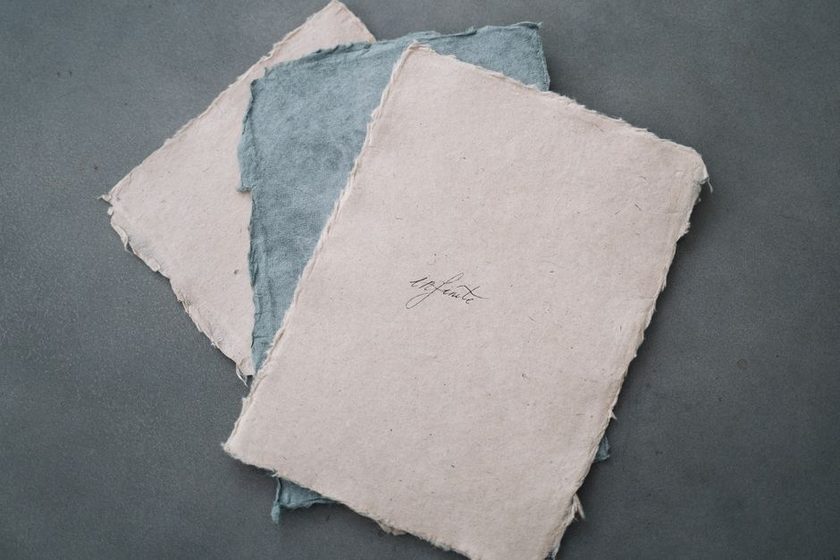
A torn edge on a heavy sheet of paper looks like an accident until you notice how consistent it is — the same soft fringe running along all four sides, never a clean corner, never a straight run for more than a few millimeters. That consistency is the giveaway. Nobody tears paper that evenly by hand, four times in a row, on every sheet in the box. The edge was built into the paper before anyone touched it, and understanding how gets at something most stationery never explains: paper used to look this way because of how the mold that made it was built, not because a maker chose a ragged look over a clean one.
What a Deckle Actually Is
Handmade paper starts as a slurry of pulp and water lifted onto a mold — a flat wooden frame strung with fine wire mesh, held and worked like a shallow sieve. Fitted around the mold's outer edge is a second, removable wooden frame called the deckle. It sits on top of the mesh like a lid with no bottom, and its only job is to keep the pulp from sliding off the mold while the water drains through. The deckle is not decorative. It is the dam that gives a sheet of handmade paper its rectangle in the first place, and its name eventually attached itself to the edge it left behind.
Why the Edge Thins There
Pulp does not sit flush against the deckle's inner wall. A little of it works its way underneath, thinning as it goes, so the fiber right at the border of the sheet is never as dense as the fiber in the middle. When the sheet is lifted off the mold and the deckle frame removed, that thinned border stays — a soft, slightly translucent fringe where the paper trails off instead of stopping outright. Hold a genuine deckle edge up to a window and the difference is usually visible: the last few millimeters let more light through than the rest of the page, because there is simply less paper there.
This is a different mechanism from tearing paper against a straightedge after the fact, which produces its own ragged edge but for a different reason — the fibers there pull apart along whatever line happens to be weakest, not along the shape of a mold's border.
The Machine-Made Problem
Once papermaking moved onto a continuous wire belt — the kind of machine that has run in mills since the early nineteenth century — the deckle edge mostly disappeared by design. A moving belt has no frame to thin the pulp against; paper forms as an unbroken web, is pressed, dried, and rolled, then cut to size with a blade long after it has left the vat. A blade makes the same edge every time: straight, sharp at the corner, identical whether it's cutting the first ream of the day or the thousandth. That uniformity is exactly what made mass-produced paper practical for offices and printers — and it also erased a texture that centuries of handmade paper had trained the eye to notice.
How Mills Fake It Now
Mills that want the look back sell it in deliberately, and the two common methods pull toward the same effect from opposite directions. One runs a fine stream of water along a guide as the web passes through, weakening the fiber along that line so it tears rather than cuts — a controlled version of the same fraying a deckle produces, though usually only along the two long edges of a sheet, since the paper still arrives from a roll rather than a mold. The other is simpler: a worker or a machine tears the paper by hand against a straightedge, the same motion anyone can manage with a ruler and a damp fingertip, just repeated consistently at scale. Neither method thins the fiber the way a true deckle does; both sit closer to a controlled tear than to a naturally uneven border. Even so, the paper announces something to the hand before a word is read, in roughly the way a stock's weight signals a letter before its first sentence does — texture arrives first, and the eye reads it as intention.
A deckle edge is a border that admits it was made by a hand and a frame, not a blade — which is exactly why paper mills spent a century learning how to fake it convincingly.
Telling the Two Apart
A stack of old family letters is the easiest place to see the difference laid out side by side — the kind of comparison that turns up unasked-for in a slow read through a drawer of inherited correspondence. Genuine deckle sheets from the same box rarely feather in quite the same way twice: one edge slightly wider than another, one corner sharper than its opposite, because each sheet was a separate pull off the mold by a hand that was never perfectly consistent. Imitation deckle, whether water-torn or hand-torn against a template, tends to repeat the same fringe pattern sheet after sheet, because the guide or the template doesn't vary from one pass to the next. Consistency, oddly enough, is the tell for the fake. Irregularity is the tell for the real thing.
How to check an edge in under a minute
- Hold the sheet to a window — a true deckle usually lets more light through in the last few millimeters than an imitation does.
- Compare two sheets from the same pack; identical fringe on every sheet points to a template, not a mold.
- Run a finger along all four sides; a genuine deckle tends to feather on every edge, while many imitations only fake the two long ones.
- Feel for thinning fiber, not just raggedness — an edge that's torn but not tapered is closer to a cut than a deckle.
Reading the Edge
Put side by side, the four common edges a letter is likely to arrive with tend to sort themselves out fairly quickly once you know what each one is doing.
| Edge type | How it's made | Typical look | Where it tends to show up |
|---|---|---|---|
| True deckle | Pulp thins under a removable frame on a papermaking mold | Soft, irregular fringe, slightly translucent at the border | Handmade or mold-made stationery, artist and print papers |
| Machine deckle | A guided stream of water or a template tear as the web passes | Ragged on the two long edges, cleaner and cut on the short ones | Most commercial "deckle-edge" invitations and note cards |
| Guillotine cut | Straight blade cut after the sheet is dried and pressed flat | Perfectly straight, sharp at the corner | Standard letterhead, everyday office and printer stock |
| Hand-torn | Torn against a ruler or edge tool by the person writing | Irregular but directional, one visible line of fiber pull | Personal notes, deliberately informal correspondence |
None of the four is better paper in any absolute sense — a guillotine-cut sheet folds and stacks more predictably, which matters more than texture for most everyday writing. What the edge changes is what a letter suggests about itself before it's unfolded, the same way a fold pattern does; that's a separate argument made at length in The Tri-Fold and Its Discontents.
A note on terminology. "Deckle edge" technically refers to the untrimmed border a mold's deckle frame leaves on handmade or mold-made paper. "Torn edge" and "feathered edge" are often used loosely for the same look on machine-made stock, whether it was water-cut, hand-torn, or perforated and pulled apart afterward. None of the three terms describes a grade of paper or a guarantee of how it was produced — they describe an appearance, and more than one process can arrive at roughly the same look. This is a description of a manufacturing texture, not a buying guide.